Choose a custom sportsbook frontend when control over specific user journeys is important enough to justify owning their implementation and maintenance. Consider a provider-managed white-label UI when its existing experience meets your requirements and the contract offers acceptable customization, support and exit terms.
Neither choice automatically determines who runs the betting engine, wallet, trading operation or regulatory processes. A custom interface can sit on a third-party platform, and a white-label arrangement can bundle different responsibilities. This is a research-based decision framework, not a benchmark of named vendors or a claim that one architecture always launches faster.
Key Takeaways
- Compare the actual interface scope and contract, not the label attached to the product.
- A custom frontend does not mean a custom betting platform.
- Verify API access, failure handling, release control and data portability before choosing.
- Compare lifecycle responsibilities and costs, including migration and support.
Define the two options precisely
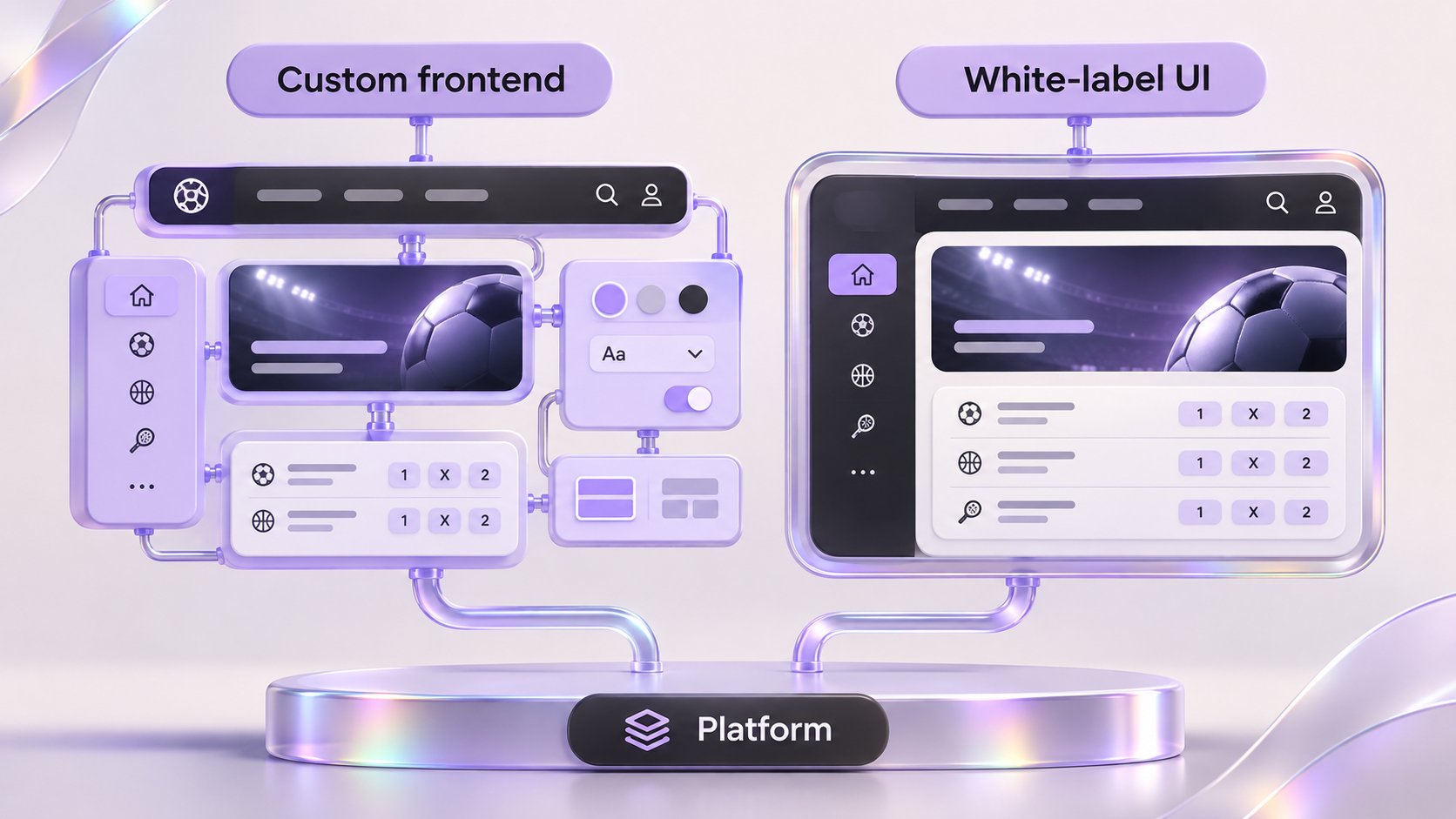
A custom sportsbook frontend is an interface built for the operator's requirements. It may include event discovery, market presentation, the betslip, account views and integrations with services supplied by other companies. The implementation boundary must be documented: a team building the interface does not automatically own the systems that accept and settle bets.
A white-label UI, as used in this comparison, is a provider-maintained interface that an operator configures or brands. Its permitted changes, release process and bundled services depend on the agreement. Some arrangements allow substantial customization; others limit changes to approved modules. Do not infer those capabilities from a sales label.
There are also intermediate options, such as a custom lobby connected to provider-managed betting screens. Evaluate each surface separately if that is the proposed architecture. A hybrid can reduce one implementation task while introducing navigation, authentication and design consistency work at the boundary.
Compare control against responsibility
Use the following table as a set of questions for your proposals. The entries describe typical ownership patterns to verify, not guaranteed vendor features.
| Decision area | Custom frontend | Provider-managed white-label UI |
|---|---|---|
| Journey design | Your team defines supported flows within API constraints | Changes depend on configuration and provider process |
| Visual system | Your team maintains components and brand behavior | Branding follows the supported customization model |
| Integration work | Your team implements agreed client and middleware responsibilities | Provider handles the contracted integration scope |
| Release control | Your delivery process governs owned code | Provider schedule and contract govern managed surfaces |
| Testing | Your team owns frontend regression and integration checks | Testing responsibilities require explicit agreement |
| Platform changes | Your team adapts to API and schema changes | Provider manages changes within its contracted product |
| Incident diagnosis | Requires visibility across your code and supplier services | Depends on provider observability and support access |
| Exit | Depends on code ownership, data access and replaceable dependencies | Depends on export rights, transition support and contract |
The useful question is not whether control is desirable. It is which decisions require your control and who can reliably operate the resulting system.
Identify the journeys that justify custom work
Write down the specific limitations you need to solve. “We want a unique experience” is difficult to estimate. “Users cannot compare these markets without losing their event context” is a testable product problem.
For each limitation, ask whether the provider can solve it through existing configuration, a supported extension or a scheduled change. Request a demonstration using your scenario. If a provider-managed UI meets the need, custom development may add ownership without adding a useful distinction.
Custom work becomes more compelling when several important journeys require changes that the managed interface cannot support. Even then, validate API access first. A design that depends on unavailable data, unsupported filters or a transaction state the provider does not expose cannot be delivered solely through frontend code.
Use a small technical and design prototype to test the hardest boundary. For example, demonstrate event browsing, one selection, a submission response and recovery from a simulated interruption. This is an evaluation exercise, not a production release or proof of full platform readiness.
Verify the integration contract before estimating
API documentation should explain more than successful responses. Review authentication, session expiry, data freshness, rate limits, error codes, transaction references and recovery procedures. Confirm which environments are available for development and testing.
Betfair's exchange documentation provides a useful example: its betting exceptions distinguish invalid sessions, request limits and timed-out operations, and specify a reconciliation step for certain timeouts. Your provider may behave differently, but the example shows why a generic “API integration” line item is insufficient. Betfair: Betting Exceptions
Ask the shortlisted supplier to demonstrate difficult states in a test environment. Can you determine whether a submission succeeded after a connection failure? Can you correlate a frontend incident with a provider request? Can you reproduce a suspended market and an expired session? Record answers as acceptance requirements rather than meeting notes.
Keep credentials and privileged operations on the appropriate server-side boundary. The final architecture should identify which requests the client can make and which require trusted services. A custom frontend proposal must include any necessary middleware or explicitly assign that work elsewhere.
Assign responsibility across the whole journey
Create a responsibility matrix before signing the implementation scope. Name the owner, supporting parties and evidence of completion for each area.
| Area | Questions the agreement must answer |
|---|---|
| Interface and design system | Who approves changes and maintains components? |
| Accounts and wallet | Which system is authoritative, and who resolves discrepancies? |
| Bet acceptance and settlement | Which provider owns outcomes and transaction records? |
| Data delivery | Who monitors freshness, coverage and interruptions? |
| Compliance configuration | Who defines jurisdiction-specific behavior and approves changes? |
| Operations | Who receives incidents, diagnoses them and communicates status? |
| Analytics | Who defines events, permissions and retention requirements? |
An agency engagement may cover UX, frontend implementation and defined integrations while leaving platform operation with the operator and supplier. That can be a coherent arrangement if the boundaries are explicit. The risk comes from gaps between contracts, such as everyone assuming someone else owns failed-transaction reconciliation.
Compare lifecycle cost with the same assumptions
Do not compare a custom build estimate against only a white-label setup fee. Request comparable schedules covering implementation, provider fees, hosting, maintenance, testing, support, required changes and exit work.
A useful planning model is:
Lifecycle cost = initial delivery + recurring platform and operating costs + planned change work + transition allowance.
Choose the same evaluation period and usage assumptions for both options. If a fee depends on activity or revenue, model the contractual calculation separately and show the assumptions. Do not present an assumed scenario as a vendor quote.
For custom development, include component maintenance, API upgrades, regression testing, accessibility work and incident response. For a managed UI, include charges or lead times for requested changes, supported-brand limits and any services excluded from the base agreement. Ask what happens when a required change falls outside the standard product.
Schedule comparisons need the same discipline. Identify dependencies such as provider access, approved content, test data and operational review. A short frontend schedule is not a complete launch schedule if those prerequisites remain unresolved.
Test release control and exit before committing
Ask how changes reach production, how they are rolled back and how compatibility is maintained. For a custom frontend, review the team's release and monitoring plan. For a managed interface, review the provider's change notifications, testing access and response process when a release breaks your configuration.
Evaluate accessibility in the working product. For example, WCAG 2.2's target-size criterion offers a concrete check for densely packed controls, with specified exceptions. Neither a custom codebase nor a managed UI passes that check by virtue of its architecture. W3C: Target Size (Minimum)
Exit planning should cover owned code, design assets, content, data exports, identifiers and transition support. Confirm which rights persist after termination. Code ownership alone does not make a product portable if essential behavior depends on a service that cannot be replaced under the available contract.
If migration is part of the plan, document how accounts, transaction history and active sessions are handled. The operator and platform teams must approve the migration design; replacing interface screens is only one part of that work.
Make the decision with evidence
Score both proposals against your most important requirements, using demonstrated capability rather than feature names. Mark unresolved questions as unknown instead of giving a supplier the benefit of an assumed capability. Treat an essential unmet requirement as a constraint, not something a favorable average score can hide.
A white-label UI is a reasonable choice when its supported journeys fit, responsibilities are clear and the contract gives you acceptable operations and exit terms. A custom frontend is reasonable when specific experience requirements are valuable, the necessary interfaces are available and you have a credible plan to maintain the result. A hybrid deserves consideration when the ownership boundaries remain understandable to both users and teams.
To scope a frontend decision, share the current platform, API access and journeys you need to change. Those inputs make it possible to discuss a concrete interface engagement without confusing it with building an entire sportsbook operation.