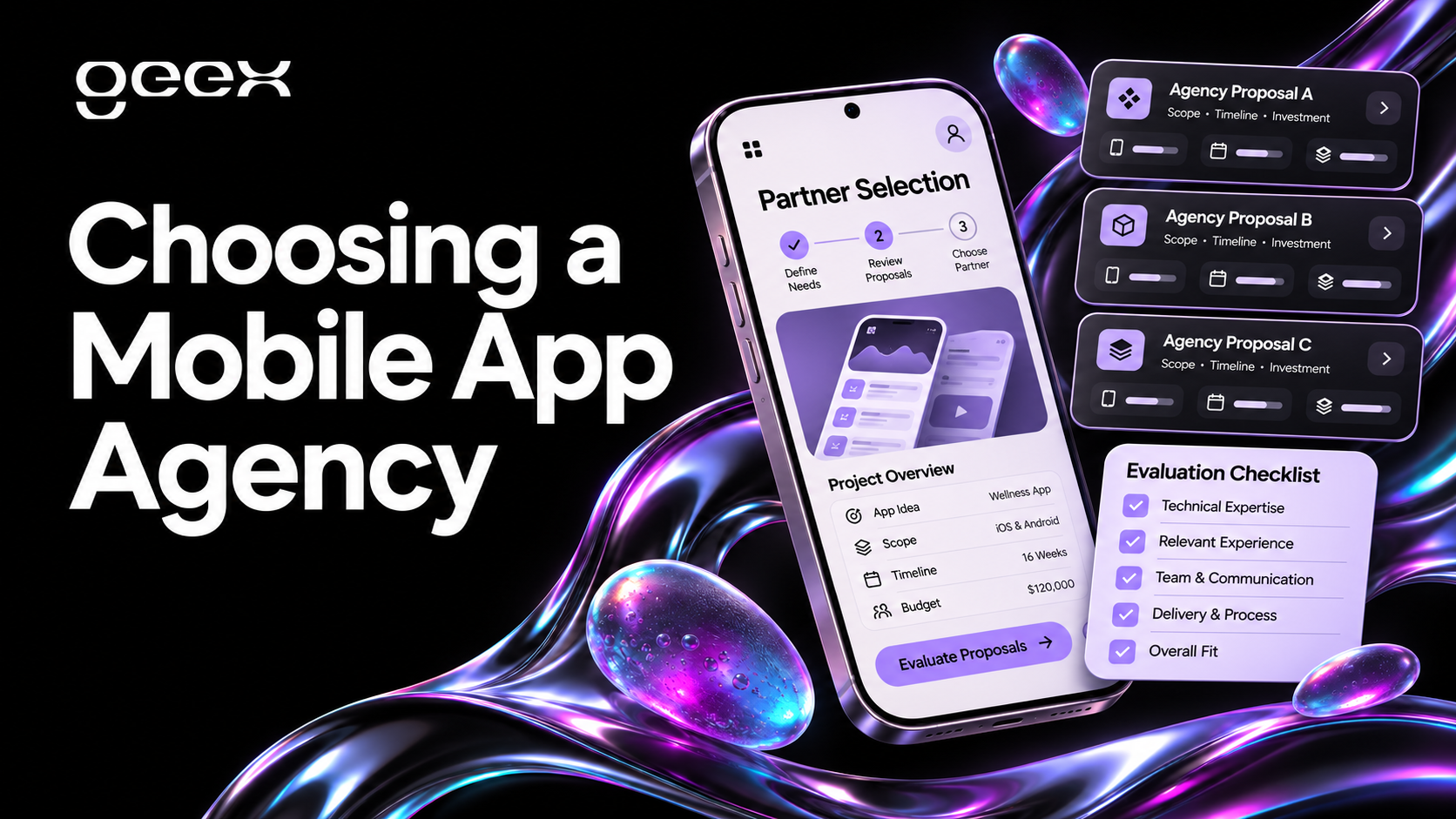
Choose a mobile app agency by testing whether its team can resolve your product's actual risks and deliver work you can operate after the engagement. A strong portfolio is useful evidence of craft, but it does not tell you who will work on your project, what the agency built or how it handles changes.
Use the same brief, questions and evaluation criteria for every shortlisted partner. Compare evidence against your needs before comparing the total price. This gives you a reasoned choice and exposes the assumptions that could otherwise become disputes during delivery.
Key Takeaways
- Verify the agency's role in each relevant project, including whether it was a concept or a shipped product.
- Meet the proposed delivery team and ask how it resolves scope and technical uncertainty.
- Compare proposals against shared deliverables, assumptions and acceptance criteria.
- Agree access, ownership, documentation and support arrangements before work begins.
Write the brief before building a shortlist
Start with the user problem, priority journeys, supported platforms and known systems. Identify what exists already: research, brand assets, designs, code, APIs or an internal engineering team. State which decisions are settled and which need expert input.
Describe the next milestone precisely. You may need a validated prototype, a launchable MVP or a redesign of an existing service. These are different engagements. An agency specializing in interface design may fit the first assignment without being the right owner for a complex backend migration.
Include your budget constraints and the reason for the target date. If the date is tied to an event or another supplier, explain that dependency. Ask candidates to challenge the scope if it does not fit. A useful response should reveal tradeoffs, not merely confirm every request.
Check what the portfolio actually proves
For each relevant project, ask what the agency did, who performed the work and what reached production. Separate branding, UX research, interface design, mobile engineering and backend work. A screenshot can show visual skill without demonstrating the engineering behind it.
Ask for a walkthrough of one difficult decision. What constraints existed? Which alternatives were considered? How was the chosen approach tested? If the team reports a business result, ask how it was measured and what other changes happened during the same period.
Concept work can still demonstrate useful thinking. It should be identified as concept work. A team that clearly explains the boundary of its contribution gives you better evidence than a broad claim that cannot be checked.
When a live app is available, explore relevant tasks yourself. Review the actual experience rather than inferring quality from a store rating alone. If possible, speak with a reference about delivery communication, handling of problems and the handoff after launch.
Meet the people assigned to delivery
Ask to meet the design and engineering leads who would work on your project. Clarify whether the proposal names committed team members or illustrative roles. Find out how staffing changes are communicated and who retains context if a contributor leaves.
Give the team a realistic problem from your brief. For example, ask how it would investigate an undocumented ticketing API or test whether users understand a new booking flow. Look for questions about evidence, constraints and acceptance criteria.
Technical recommendations should relate to the product. Android's architecture guidance discusses separation of responsibilities, app state and lifecycle behavior. You do not need to prescribe an architecture, but you can ask the proposed lead how the team will handle those concerns in your application. Android app architecture guide.
An interview should test communication too. Can the team explain a tradeoff in language your decision-makers understand? Does it distinguish something it knows from something it needs to investigate?
Compare proposals on the same basis
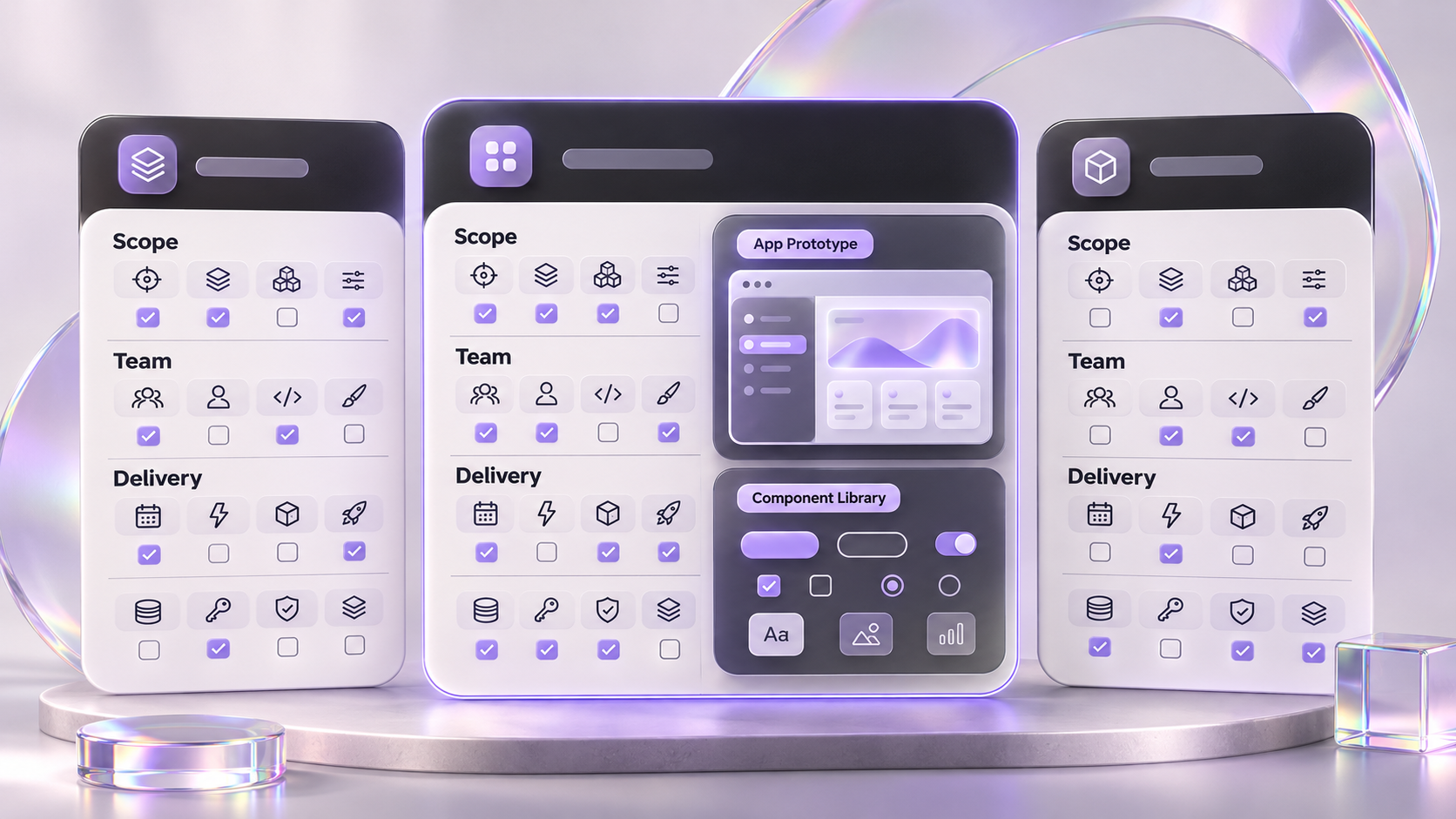
A fixed price is only meaningful with defined scope. A time-based engagement still needs a budget control process. In either model, ask for deliverables, assumptions, exclusions, review points and the process for approving changes.
| Proposal area | Evidence to request | A question to ask |
|---|---|---|
| Scope | Journey inventory and explicit exclusions | Which required tasks are outside this estimate? |
| Design | Research, prototypes, states and handoff | What will be tested before implementation? |
| Engineering | Architecture and integration plan | Which dependencies are not yet validated? |
| Quality | Test matrix and acceptance checklist | Who decides a release is ready? |
| Delivery | Named roles, cadence and decision owner | What happens when feedback conflicts? |
| Operations | Support, access and documentation | Who can operate the product after handoff? |
Separate design, implementation and ongoing operations so that differences are visible. Check whether research recruitment, content migration, vendor subscriptions and release preparation are included. When a line item is missing, treat it as an open question rather than a saving.
Ask how progress is demonstrated. A working build and a discussion of unresolved risks usually provide more decision value than a percentage-complete report with no agreed definition of completion.
Agree security and accessibility evidence
Request a security approach that matches the app's data and actions. OWASP MASVS provides a structured reference for mobile security controls. Ask which relevant controls the team will assess, who performs the work and what findings or remediation evidence you will receive. OWASP MASVS.
For accessibility, ask which platform guidance and acceptance criteria apply, which assistive technologies will be tested and who will review the implemented experience. Screenshots alone cannot verify the behavior of a screen reader or keyboard interaction. W3C explains WCAG's testable criteria and its application to web content, with additional guidance for non-web technology. W3C WCAG overview.
Avoid treating the name of a standard as proof of conformance. The useful evidence is the agreed scope, the assessment performed and the handling of identified issues.
Keep access and handoff explicit
Agree how your organization will access design files, source code, build configuration, infrastructure and operational documentation. Decide which accounts belong to the client organization and which permissions the agency needs. Use individual roles where the service supports them instead of sharing a single login.
Apple distinguishes an organization's Account Holder responsibilities from the access assigned to additional team members. That makes account setup an operational decision to resolve before release preparation. Apple Developer roles and access.
Ask for a handoff rehearsal: can another authorized person build the app, locate configuration documentation and understand how to release an update? Clarify ownership terms, third-party licenses and exit assistance in the agreement with the appropriate commercial advisers. The operational checklist does not replace a review of the contract.
Support needs the same clarity. Define who receives production alerts, how incidents are triaged and what support includes. Distinguish defect correction from new feature requests, and establish who approves additional work.
Use a scorecard, then discuss the gaps
The following weights are a suggested decision aid, not an industry standard. Adjust them to your project before evaluating suppliers so you do not change the rules to favor a preferred candidate.
| Criterion | Example weight | Evidence for a strong score |
|---|---|---|
| Relevant delivery evidence | 25% | Verified contribution to comparable work |
| Proposed team and communication | 20% | Credible leads and clear decision process |
| Scope and technical reasoning | 20% | Explicit assumptions and justified approach |
| Quality and operational readiness | 20% | Test plan, handoff and support ownership |
| Commercial fit | 15% | Transparent price and manageable commitments |
Score each criterion from one to five and calculate the weighted average. Record the evidence behind each number. Mark unknowns separately; a lack of evidence should not receive an average score merely to complete the table.
Use essential requirements as pass/fail checks before the weighted comparison. If a supplier cannot meet a mandatory integration constraint or provide the required access model, a high visual-design score does not resolve that gap.
Start with a defined next commitment
When important uncertainties remain, a bounded discovery engagement can be the right next step. Specify its outputs: validated integration assumptions, a prioritized scope, a prototype or a build plan. Agree how you can use those outputs if another team completes the project.
The strongest choice is the agency whose evidence, team and working approach fit your product's needs. Make the first commitment specific enough to evaluate, and preserve a clear path from that work to the next decision.
Send a project brief with your product goals, existing assets and the questions you need a delivery partner to resolve.