Mobile app design cost depends on the decisions the design team must resolve, the journeys it must specify, and the evidence needed before development. A quote based only on a screen count hides much of that work. Ten screens for a simple content app can represent a smaller assignment than five screens for booking, payment and cancellation.
For a useful budget, separate discovery, interaction design, visual design, validation and development handoff. Then ask each agency to price the same scope. The worksheet below shows how to do that, including a hypothetical calculation you can replace with your own estimates.
Key Takeaways
- Price complete user journeys and their important states, rather than counting polished screens alone.
- Keep design fees separate from engineering, infrastructure and ongoing operations.
- Make research, feedback rounds, platform coverage and handoff explicit in every proposal.
- Use a budget range until the team has resolved the assumptions that materially affect effort.
Define what the design budget includes
A design engagement should end with decisions and artifacts that another team can use. What those artifacts look like depends on your next step. An investor presentation, a usability test and a production build need different levels of detail.
| Workstream | Typical output to request | Question that changes the scope |
|---|---|---|
| Product discovery | Prioritized journeys, assumptions and constraints | Is the product direction settled? |
| UX design | Flows, information architecture and wireframes | How many user roles and exceptions exist? |
| Visual design | Interface screens and reusable components | Is there an established brand and component library? |
| Validation | Prototype, test plan and findings | Can the team recruit suitable users? |
| Handoff | State specifications, assets and implementation notes | Will developers need design support during the build? |
Ask which deliverables are included, who accepts them and what happens when feedback changes the agreed direction. A proposal that includes research and implementation support cannot be compared directly with one that supplies static mockups.
Development is a separate budget. A design file does not implement authentication, connect a payment provider, configure analytics or submit an app to a store. If one partner provides both services, request separate line items so you can see the cost of each phase and the dependencies between them.
Count journeys, roles and states
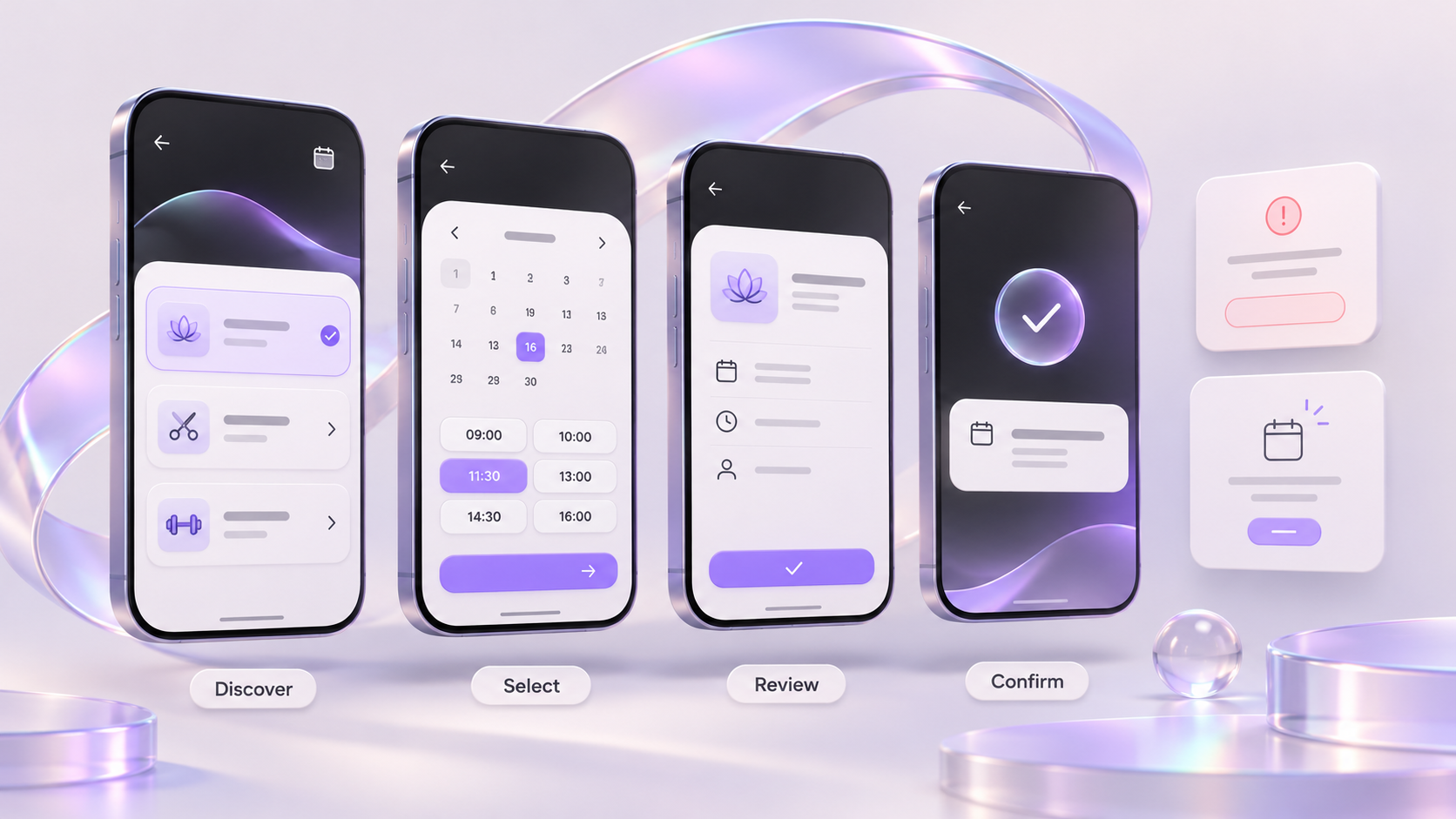
Start with the tasks that make the app useful. For a booking product, these might be finding availability, making a booking, changing it and resolving a payment problem. Identify who performs each task: a customer, a service provider or an administrator.
Then map the states within each journey. A booking screen might need available, unavailable, loading, failed payment, expired session and confirmed states. Some states share a layout; others require a different decision or recovery path. The estimate should reflect that distinction instead of treating every state as an entirely new screen.
Use a short scope record for each journey:
- User and purpose: who needs to accomplish what?
- Start and finish: what initiates the task, and what confirms completion?
- Data and dependencies: which systems supply the information?
- Exceptions: what can fail, change or become unavailable?
- Coverage: which languages, devices and accessibility needs matter?
- Acceptance: what must be demonstrated before the design is approved?
A useful acceptance statement is specific: “A returning customer can find an existing booking, understand the cancellation terms and confirm a cancellation in the prototype.” “The app should feel intuitive” is an aspiration, not an acceptance test.
Decide how much evidence you need before building
Research effort should follow uncertainty. If the team already has credible evidence about the audience and task, the next step may be testing a proposed flow. If the audience or problem is unclear, polishing screens will not resolve those questions.
Prototypes also have different purposes. A rough flow can help test navigation, while a more detailed interactive prototype can explore the language and feedback around a sensitive action. Nielsen Norman Group distinguishes prototype fidelity by how closely the prototype represents the finished experience; fidelity is a choice for the research task, not a quality score for the project. Read its guide to prototype fidelity.
Ask the team to name the questions a test should answer. For example: Do users understand the difference between saving a booking and paying for it? Can they recover after selecting an unavailable time? Specify participant recruitment, session preparation, analysis and the revision round after testing. These activities take effort even when the prototype itself is small.
Include accessibility and platform behavior early
Text size, contrast, interaction labels and alternative ways to complete a task affect the design from the beginning. Apple's accessibility guidance covers considerations such as adaptable text and support for assistive technologies. These belong in the design brief and implementation review. Apple accessibility guidance.
For a web-based app, agree the relevant WCAG criteria and testing approach. For native apps, use platform guidance alongside applicable accessibility requirements; W3C also provides guidance for applying WCAG to non-web technology. A design review alone cannot establish that the finished application is accessible. W3C WCAG overview.
Clarify whether the engagement covers iOS, Android, tablets and landscape layouts. Shared visual language can reduce repeated work, but each supported context still needs a decision about navigation, layout and behavior. The same applies to localization: translated text can change the space a component needs.
Build a transparent estimate
The following is an illustrative calculation, not a market benchmark, a Geex Arts quote or a record of a client project. It uses an invented hourly rate and invented effort assumptions to show how the budget works.
| Workstream | Hypothetical hours | At an assumed $100 per hour |
|---|---|---|
| Discovery and scope definition | 24 | $2,400 |
| Journeys and wireframes | 40 | $4,000 |
| Visual design and components | 64 | $6,400 |
| Prototype and usability review | 24 | $2,400 |
| Handoff and implementation clarification | 16 | $1,600 |
| Base design effort | 168 | $16,800 |
If this hypothetical project sets aside a 15% reserve, the reserve is $2,520 and the planning total is $19,320. Taxes, paid research recruitment, software subscriptions and engineering are excluded. Replace every assumption with your own supplier's scope and rates before using the calculation for purchasing.
A reserve covers uncertainty within a defined scope. It should not silently absorb a new user role, a second product or a major change in direction. Agree which changes trigger a revised estimate and who can authorize them.
For a fixed fee, ask the same questions even if the agency does not disclose hours. You still need the deliverables, assumptions, acceptance criteria, exclusions and change process that explain the price.
Compare proposals without losing the useful work
Put competing proposals beside the same journey inventory. Check whether each covers research, content, exceptions, responsive layouts, testing and handoff. Mark omissions as unknown rather than assuming they are included.
Next, ask who will do the work and how decisions will be reviewed. A smaller senior team may organize work differently from a larger multidisciplinary team. Assess whether the proposed roles fit the scope, rather than treating headcount as a benefit by itself.
If the budget is too high, remove a journey or defer a platform before cutting the review work that tells you whether the core experience is understandable. You can also reuse an existing component library, limit custom illustration or postpone secondary personalization. Keep accessibility, recovery paths and essential implementation detail in the scope.
Prepare the brief that produces a useful quote
Send agencies a concise package: the audience, the problem, the must-have journeys, supported platforms, current research, available brand assets and known technical constraints. Add the target milestone and distinguish a firm launch commitment from a preferred date.
Ask each agency to return its assumptions and open questions with the estimate. A useful first conversation should reveal uncertainty and explain how to reduce it. The output is a design budget you can revise deliberately as the product becomes clearer.
Request an app design estimate with your journey list and existing product material.